01 / FINAL-YEAR PROJECT / PROTOTYPE RESEARCH SYSTEM
VORMA
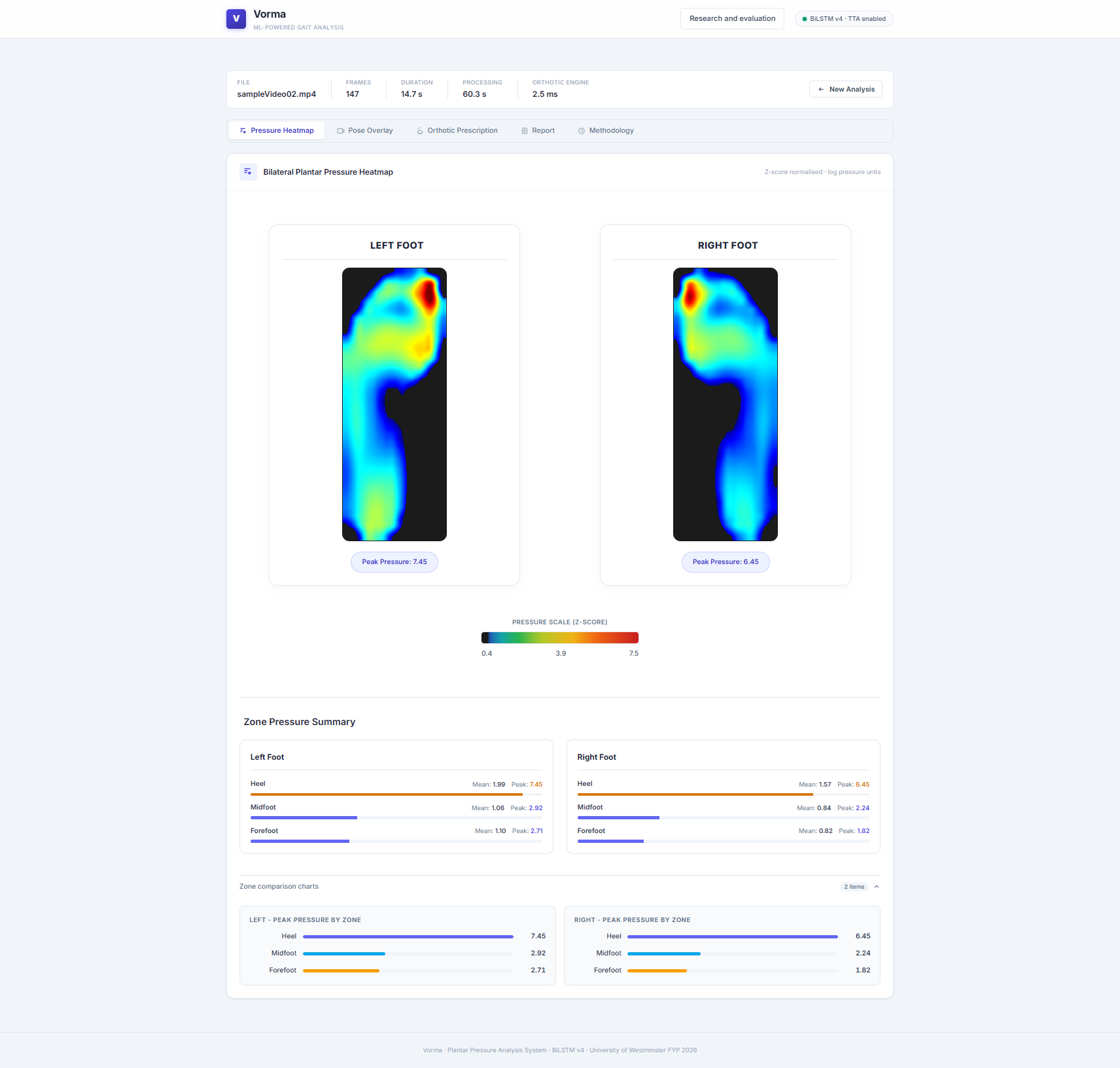
A full-stack gait-analysis platform that predicts plantar-pressure maps from video and generates personalised orthotic recommendations.
- ROLE
- SOLO RESEARCHER & DEVELOPER
- PERIOD
- 2025–2026
- RESULT
- Seed-42 held-out test: 2.073 RMSE across 4,247 frames.
OVERVIEW
Plantar-pressure measurement typically requires specialised hardware. VORMA investigates whether temporal gait features extracted from monocular RGB video can predict bilateral baropodometric pressure maps and support personalised orthotic recommendations.
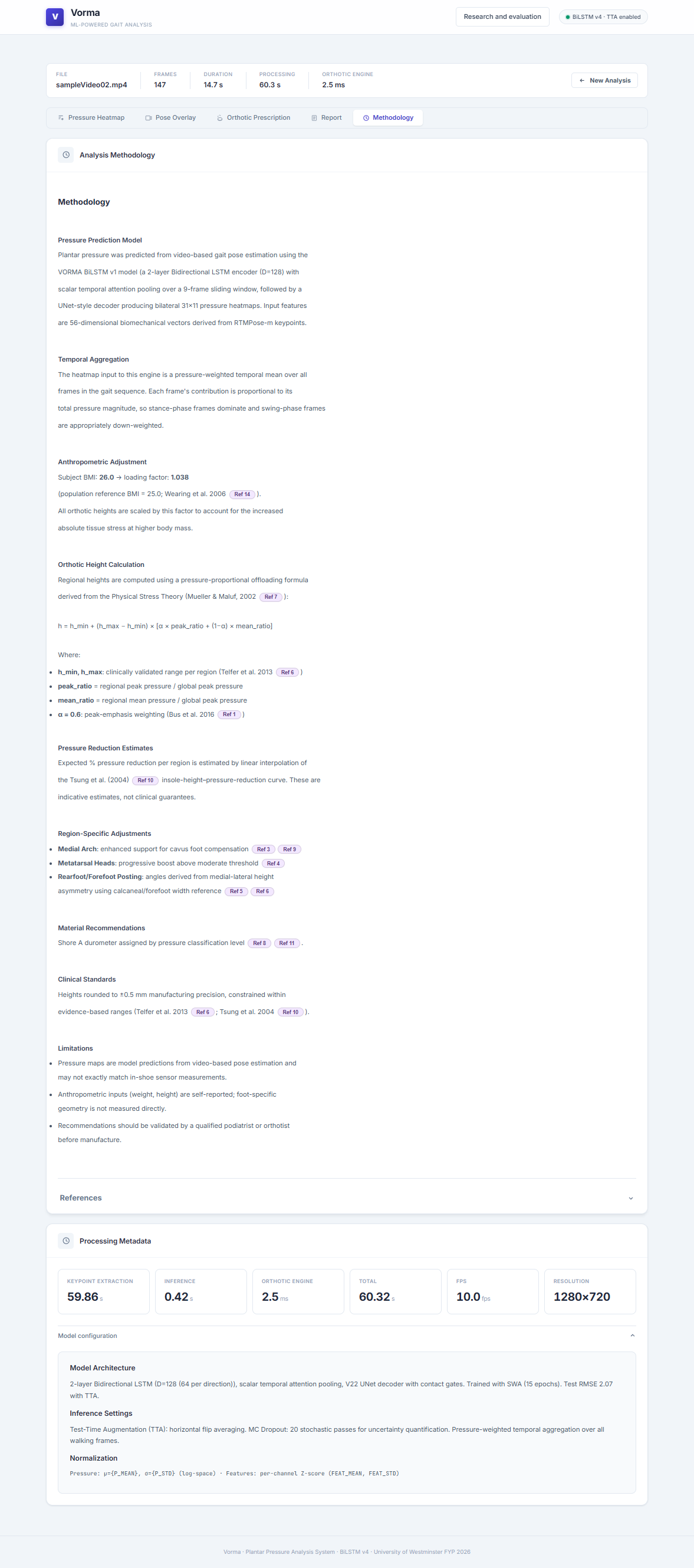
The system combines RTMPose gait-feature extraction, a BiLSTM pressure-prediction model, split-conformal uncertainty calibration, and a PWRI-validated orthotic recommendation engine in a Next.js and FastAPI platform.
PLATFORM SCREENS


SYSTEM ARCHITECTURE
01
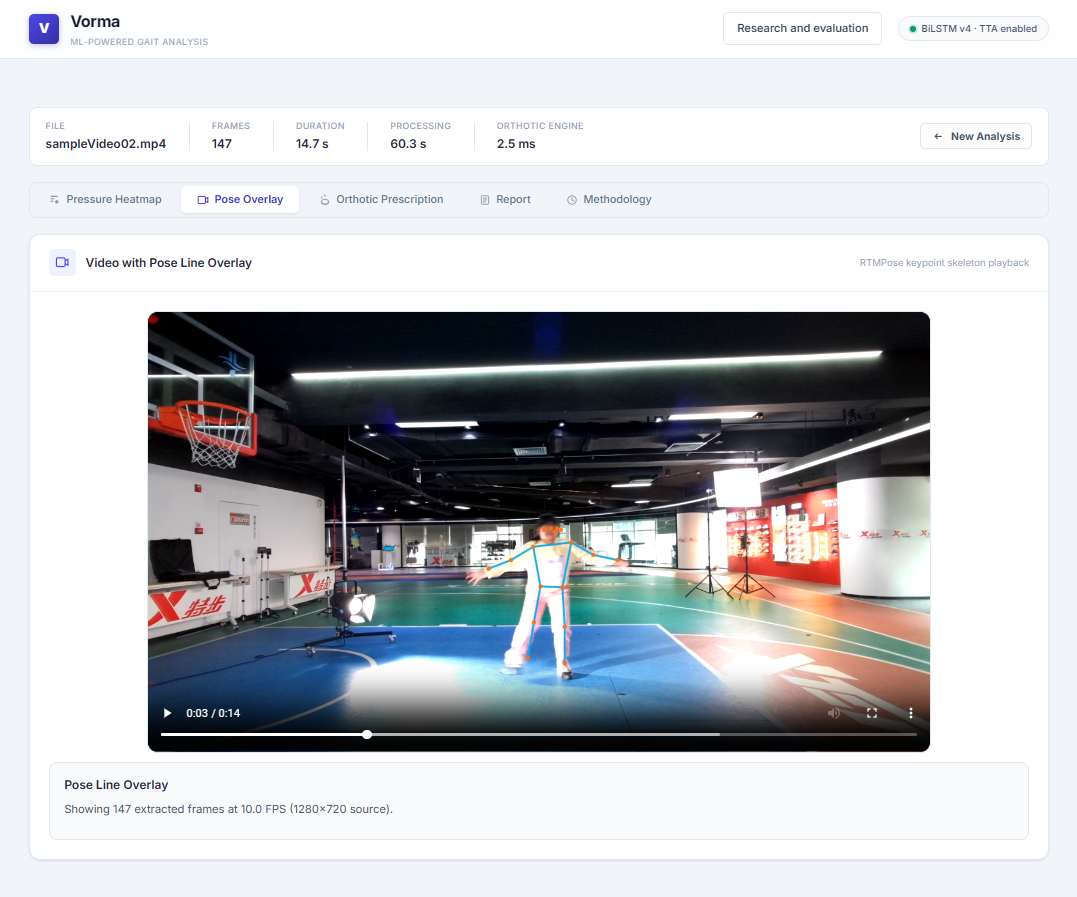
RTMPose gait feature extraction
Markerless pose estimation extracts temporal biomechanical gait features from monocular RGB video.
02
Temporal plantar-pressure prediction
A BiLSTM uses temporal gait dynamics to reconstruct bilateral baropodometric heatmaps.
03
Conformal uncertainty calibration
Split conformal prediction produces calibrated, region-wise confidence bands.
04
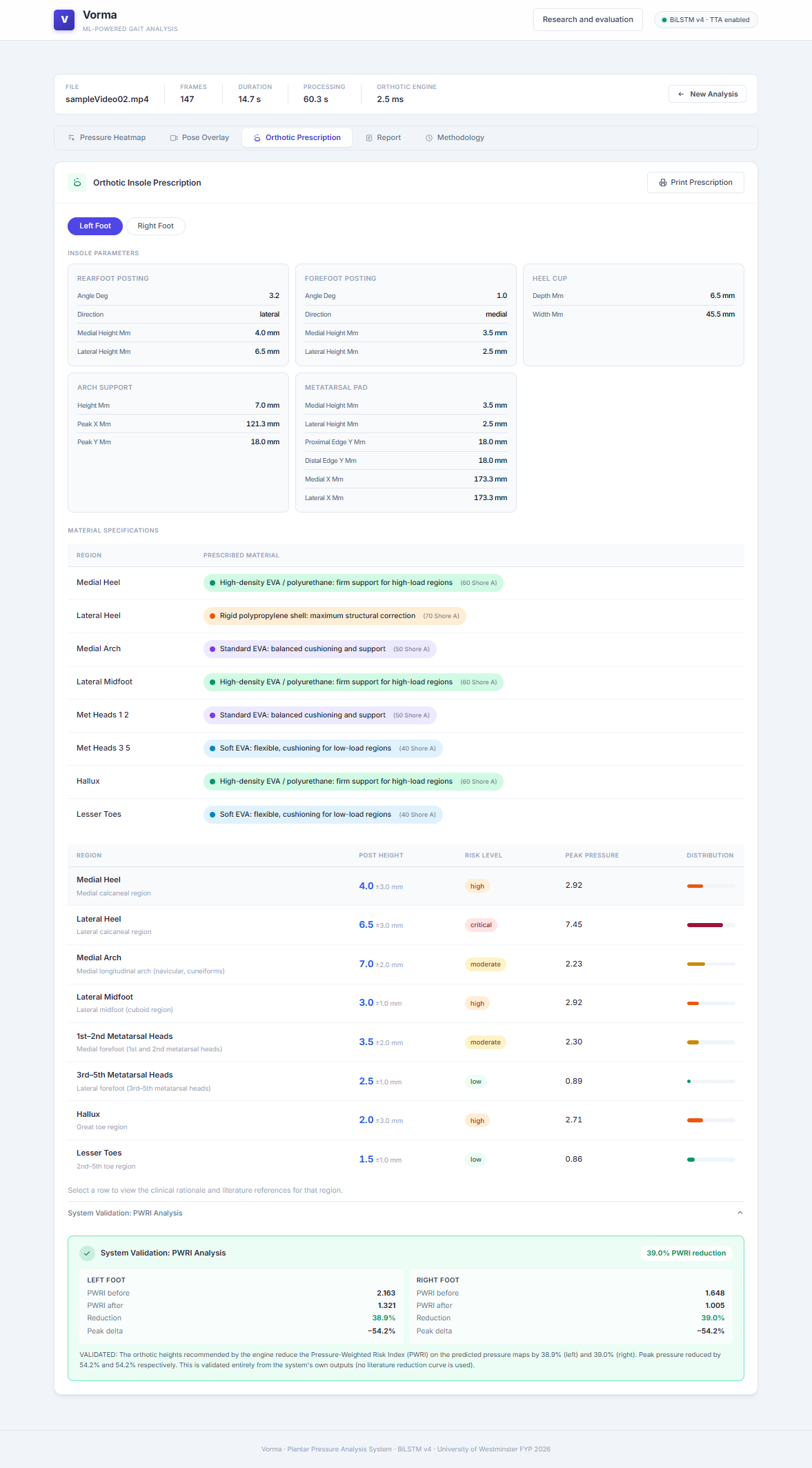
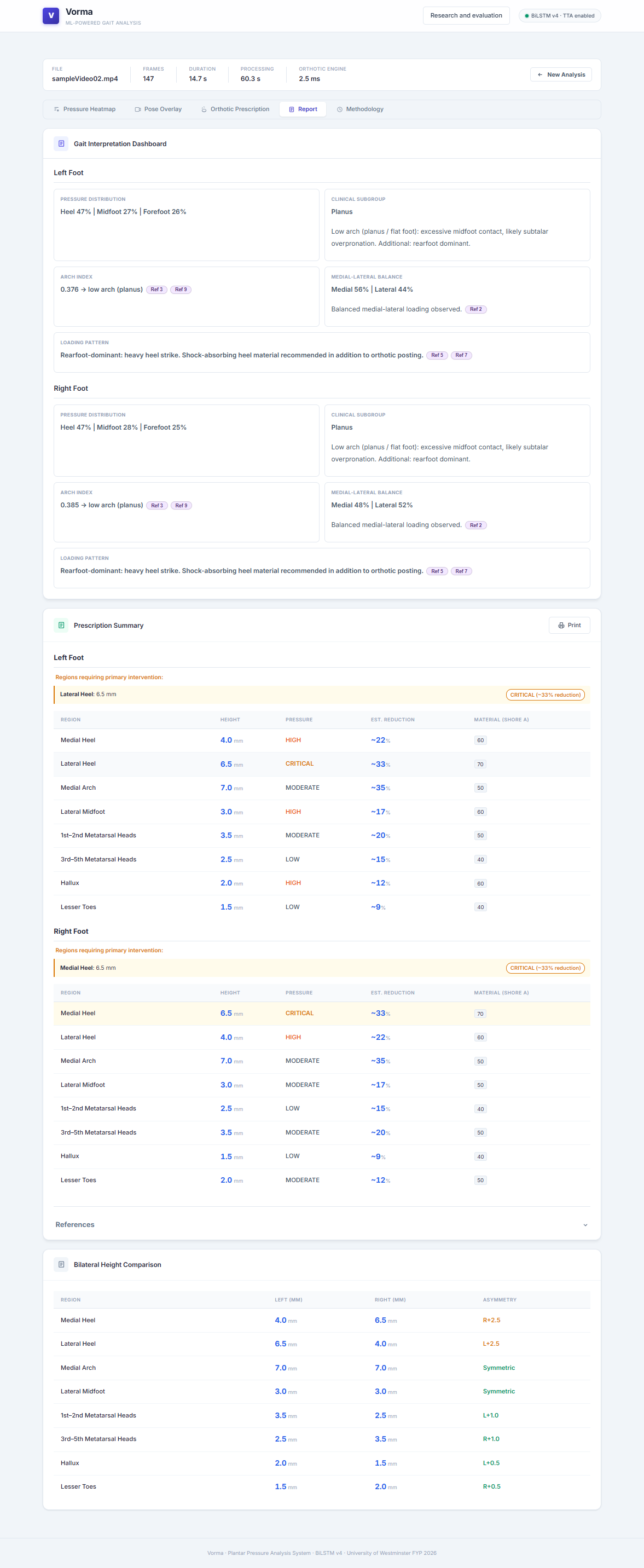
Orthotic recommendation & PWRI validation
Personalised prescriptions are derived from heatmaps and evaluated through PWRI reduction.
FIXED-SPLIT EVALUATION
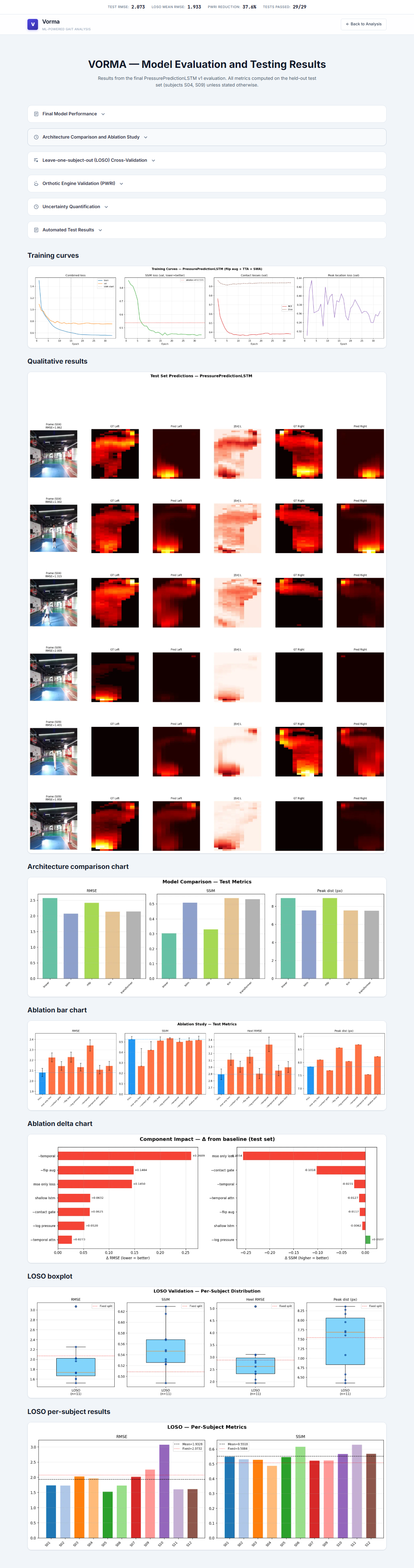
BiLSTM v4 was trained on eight MMVP subjects. S03 was held out for validation; S04 and S09 were held out for testing. Reported values below are the approved seed-42 fixed-split result across 4,247 test frames.
- TEST RMSE
- 2.073SEED 42 · S04 + S09
- TEST MAE
- 1.1124,247 HELD-OUT FRAMES
- TEST SSIM
- 0.508FIXED HELD-OUT SPLIT
- PWRI REDUCTION
- 37.6%S04 + S09 MEAN
| SPLIT | RMSE | MAE | SSIM | PEAK DISTANCE (PX) |
|---|---|---|---|---|
| Validation / S03 | 1.994 | 1.023 | 0.535 | 8.829 |
| Test / S04, S09 | 2.073 | 1.112 | 0.508 | 7.542 |
VALIDATION & REPRODUCIBILITY
BOOTSTRAP / 1,000 RESAMPLES
RMSE 2.081
95% confidence interval: 2.041–2.122. The bootstrap analysis is preserved separately from the seed-42 fixed-split result.
MULTI-SEED / 3 RUNS
2.7% CV
Three independent runs with identical hyperparameters produced a 2.7% coefficient of variation for RMSE.
LOSO / 11 SUBJECTS
1.933 ± 0.418
Mean RMSE across leave-one-subject-out folds. S10 is documented as an outlier due to pressure-distribution representation.
UNCERTAINTY / SELECTED METHOD
Conformal prediction
Selected after MC Dropout and a deep ensemble failed calibration. Global 90% test coverage was 0.853 with S03-only calibration.
ORTHOTIC ENGINE VALIDATION
The prescription engine reduced mean PWRI by 37.6% across S04 and S09. A one-sided t-test reported t = 39.7 and p ≈ 0.
S04 REDUCTION
36.3%
S09 REDUCTION
39.0%
MEAN PEAK REDUCTION
51.9%
VALID PRESCRIPTIONS
2 / 2
AUTOMATED TESTING
| SUITE | PASSED | DURATION | ENVIRONMENT |
|---|---|---|---|
| Unit | 12 / 12 | 3.12 s | Python 3.11 / pytest 9.0.3 |
| Integration | 5 / 5 | 246.28 s | FastAPI on localhost:8000 |
| Frontend E2E | 12 / 12 | 217.70 s | Playwright / Chromium, Firefox, WebKit |
TOTAL / 29 OF 29 TESTS PASSED
CHALLENGES
- 01Generalising from a small MMVP subject set while preserving a strict subject-held-out evaluation protocol.
- 02Making model uncertainty visible at a regional level instead of presenting a single unqualified prediction.
- 03Validating the complete platform with unit, integration, and browser end-to-end tests.
LESSONS LEARNED
The evaluation protocol is part of the product. Fixed-split, multi-seed, bootstrap, and leave-one-subject-out results are deliberately reported separately so each result retains its context.
TECHNOLOGY
VORMA IS A PROTOTYPE RESEARCH SYSTEM. IT IS NOT A CLINICAL PRODUCT OR MEDICAL DEVICE.